Skip to content
INTEGRATED ANNUAL REPORT 2025

Our Strategy

With a diversified generation portfolio spanning 5 technologies across 32 power plants, Enerjisa Üretim is one of Türkiye’s largest private electricity producers, operating in one of Europe’s largest and fastest-growing electricity markets. The energy sector is changing rapidly as decarbonization, electrification, digitalization and evolving market conditions reshape how electricity is produced, traded and consumed. According to Türkiye’s National Energy Plan, electricity demand is expected to increase from 361 TWh in 2025 to approximately 455 TWh by 2030, supported by industrial growth, manufacturing investments linked to nearshoring, accelerating electrification, expanding data center capacity and rising cooling demand. Maintaining system reliability while increasing renewable energy capacity is therefore becoming important. Flexible and dispatchable generation assets play a central role in supporting system reliability and enabling the energy transition.

In this environment, the ability to deliver reliable, flexible and lower-carbon generation is increasingly critical for both system stability and long-term value creation.

As of December 31, 2025, we operate 4,333 MW of installed capacity, providing a balanced portfolio of renewable, flexible and baseload generation assets with renewables representing 53% and flexible capacity respresenting 63% of the total. Alongside electricity generation, we continue to expand our capabilities in energy trading, digital operations and data-driven decision-making to support long-term value creation and operational performance.

Our strategy is based on an integrated operating model that brings together generation, trading, digital operations and sustainability priorities under a single management approach. Through centralized operations, advanced analytics and integrated commercial capabilities, we improve portfolio performance, strengthen operational resilience and support the increasing integration of renewable energy into the electricity system. In 2025, this approach supported top-quartile availability levels across generation technologies as verified by EPİAŞ;

24/7 centralized remote operations monitoring and dispatching our full generation portfolio across five technologies through the Senkron Remote Operations Center (ROC); active energy trading across 18 European markets and 30 countries in power, gas and environmental products through Enerjisa Commodities; and an externally offered digital operations and cybersecurity platform managing more than 9 GW of installed capacity across 15 countries and four continents, covering over 50 critical sites and 40,000 assets, through Senkron Digital.

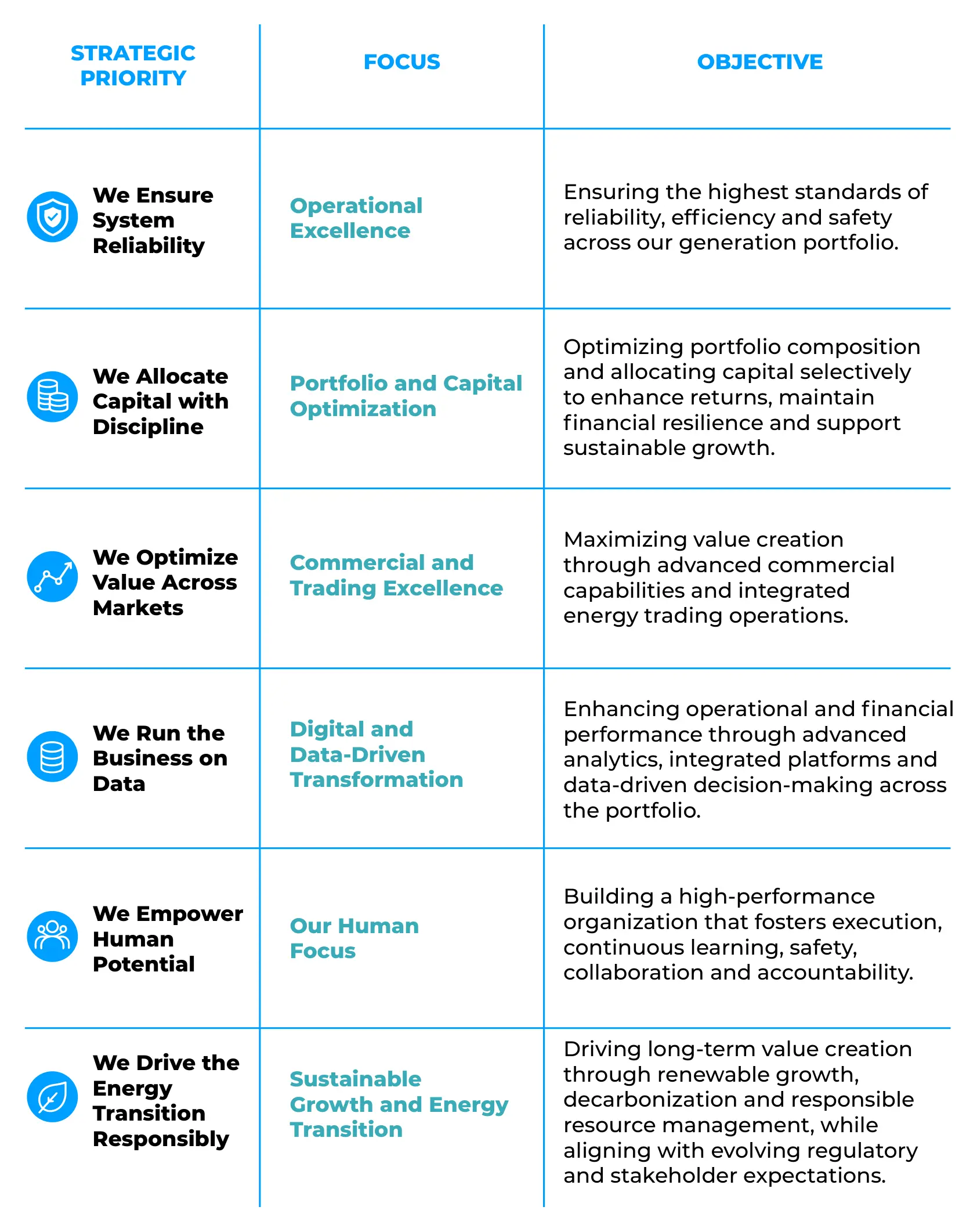
We see the energy transition as a long-term shift that requires operational flexibility, technological capability and disciplined capital allocation. Our strategic direction is organized around six priorities that guide investment decisions, risk management and value creation. Together, these priorities enable us to balance growth, financial discipline, portfolio resilience and our contribution to Türkiye’s energy transition.

What differentiates our business model is the integration of diversified generation assets, trading capabilities and centralized digital operations within a single platform.

Our portfolio spans five generation technologies, including natural gas, domestic lignite, hydro, wind and solar. This diversity provides flexibility across different market and system conditions. Enerjisa Commodities and Senkron further strengthen our operating model by improving portfolio visibility, operational coordination and decision-making.

As Türkiye’s electricity system evolves, flexibility and resilience are becoming increasingly important. The combination of dispatchable and renewable generation, integrated trading capabilities and centralized operations helps us maintain system reliability and optimize value across the portfolio.

Our long-term growth is supported by one of Türkiye’s largest private renewable investment programs, anchored by YEKA-scale wind projects, providing both capacity expansion and earnings visibility. At the same time, our Net Zero 2040 commitment provides a clear direction for portfolio transformation and decarbonization, aligned with evolving regulatory expectations and stakeholder priorities.

Our approach to transition extends beyond asset transformation and emission reduction. Through our Tufanbeyli Just Transition Roadmap, we are strengthening workforce reskilling, supporting regional development and enhancing community resilience, ensuring that the transition is both operationally viable and socially sustainable.
Our Strategic Priorities

Image
Image

WE ENSURE SYSTEM RELIABILITY

Operational Excellence

We ensure operational excellence across our diversified generation portfolio through an operating model built on reliability, efficiency, safety and disciplined governance. As energy systems become more dynamic and market patterns more volatile, we manage our generation portfolio as an integrated portfolio through centralized coordination, advanced asset management practices and digitalized operational infrastructure that support system reliability, operational continuity and adequacy across all operating conditions.

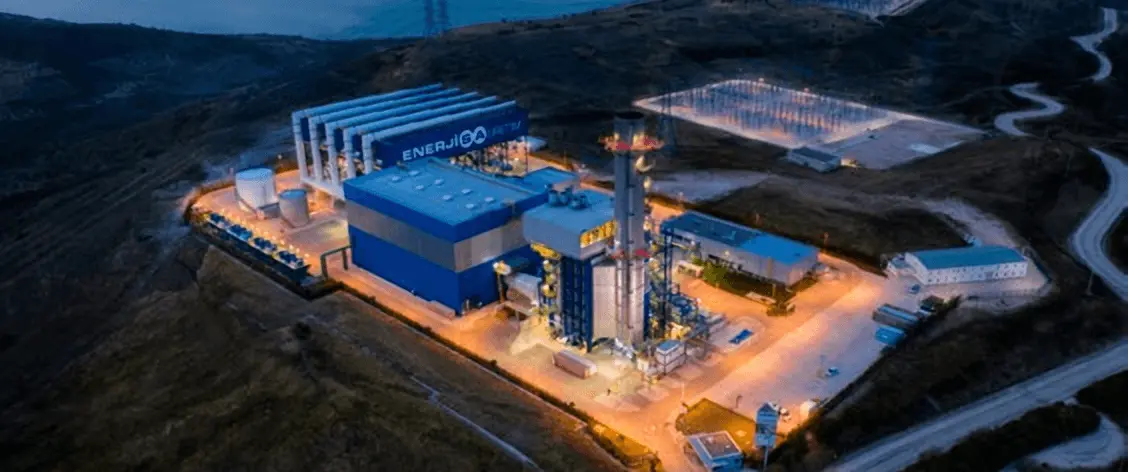
We operate a large-scale and diversified power generation portfolio designed to balance energy security, operational flexibility and sustainability. Our portfolio is structured to reflect Türkiye’s generation needs while gradually shifting toward a higher share of renewable and domestic resources. Each generation technology plays a distinct role in supporting portfolio resilience and value creation. Reservoir hydroelectric assets provide flexibility and optimization opportunities across varying hydrological and market conditions, while run-of-river hydro plants contribute reliable renewable generation linked to natural river flows. Wind and solar assets support long-term growth in renewable capacity and position the portfolio to capture growing electricity demand from electrification while supporting system decarbonization. Our Bandırma Energy Base provides the flexibility required to balance intermittent renewable generation and respond to changing market conditions. Tufanbeyli Energy Base contributes domestic baseload generation and system adequacy, supporting system reliability during Türkiye’s energy transition.

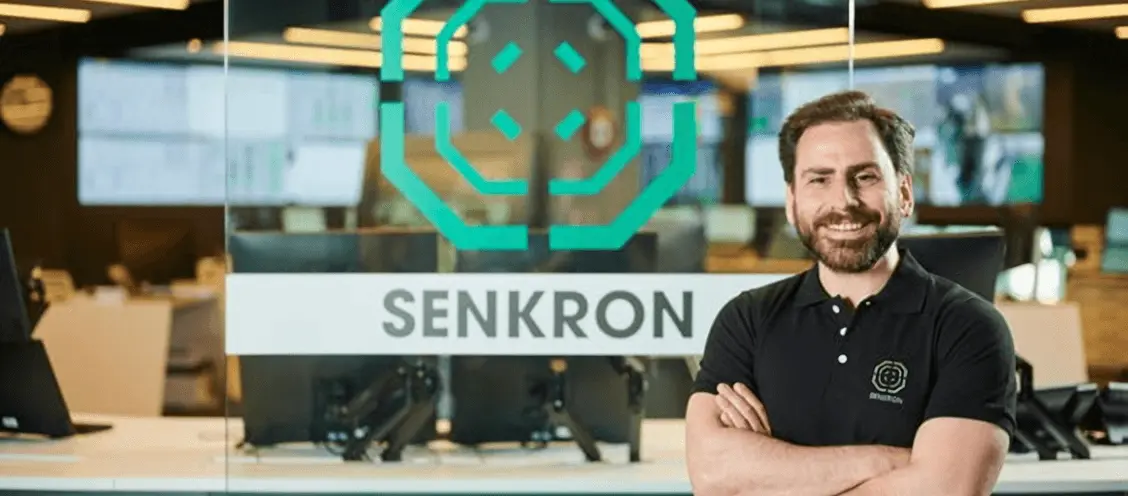
Centralized operational management is a core component of this operating model. Through Senkron ROC, we provide centralized, 24/7 oversight across all five generation technologies, enabling reliable, efficient and safe operations at portfolio scale. Standardized operating procedures, unified KPIs and centralized monitoring systems support consistent operating standards and portfolio-wide visibility across geographically dispersed assets. Beyond our own portfolio, the ROC extends these capabilities to third-party asset owners through a ROC-as-a-Service approach, positioning Enerjisa Üretim as a managed operations partner rather than a technology vendor.

Reliability is reinforced through real-time monitoring, advanced SCADA systems and centralized alarm management infrastructure. Operational conditions, asset health and grid conditions are continuously monitored to support early identification of anomalies, proactive intervention and continuity. This centralized model supports high availability levels and consistent operating standards across the portfolio.

We manage our generation portfolio with a lifecycle perspective spanning development, commissioning, operations and long-term optimization. By combining technical expertise, data-driven asset management and proactive maintenance practices, we balance operational performance, reliability, risk management and capital efficiency across different technologies and market conditions. This approach supports investment decisions, extends asset value, maximizes asset availability and helps maintain portfolio resilience as the energy system continues to evolve.

Integrated governance processes provide visibility across the portfolio, enabling a more consistent assessment of priorities, investment needs and performance improvement opportunities. By connecting asset management with capital allocation and operational planning, we optimize long-term portfolio performance while supporting reliability, flexibility and growth. Technical, operational and business teams work together to identify risks, evaluate technical priorities and strengthen continuity across different technologies and operating environments, while technical risks and priorities are reviewed regularly through structured governance mechanisms involving executive leadership, supporting alignment between operational decisions, technical standards and long-term resilience objectives.

Process safety and operational risk management are integrated into daily operational decision-making through Hazard and Operability (HAZOP) analyses, technical risk reviews and integrity management processes.
OT/ICS governance and cybersecurity management are delivered through a dedicated Security Operations Center (Senkron SOC) that operates in real-time coordination with the ROC shift team, supporting continuity and infrastructure reliability through structured lifecycle management practices aligned with internationally accepted models.

Operational excellence is further reinforced through a culture of continuous improvement, organizational learning and employee participation. Through the Üretenler Suggestion System, our employees contribute improvement ideas through structured technical, operational and financial evaluation processes, while knowledge-sharing platforms, best-practice dissemination and cross-functional collaboration strengthen organizational learning across sites and business functions. A dedicated ESG Compliance function operates as a second line of defense, independently evaluating project performance and site-level practices to support alignment with internal standards and international requirements.

Image

This operational foundation, from top-quartile availability verified by EPİAŞ to centralized governance across 32 power plants and a 30-year track record spanning development, construction, commissioning and operation of energy assets, strengthens reliability, efficiency, safety and long-term resilience across the portfolio while providing the credible base on which disciplined portfolio growth and capital allocation decisions are built.

Image

WE ALLOCATE CAPITAL WITH DISCIPLINE

Portfolio and Capital Optimization

We optimize and strengthen our generation portfolio through a strategy built on scale, diversification and disciplined capital allocation, ensuring resilient performance and sustainable long-term value creation across an evolving energy system. Portfolio optimization is approached as a continuous process that balances reliability, flexibility, decarbonization and financial and operational sustainability, rather than capacity growth alone. This approach explicitly incorporates transition-related risks, including carbon pricing exposure, asset repositioning risks and the long-term transformation of legacy generation within a decarbonizing energy system. Each investment is subject to a disciplined evaluation framework, prioritizing risk-adjusted returns and strategic portfolio fit, while ensuring earnings visibility, system contribution, regulatory feasibility and balance-sheet resilience before capital is committed.

At the center of our operating model is a diversified generation portfolio with 4,333 MW of installed capacity, combining baseload, flexible and renewable generation assets. Baseload generation provides continuity and earnings stability, flexible assets support balancing requirements and market responsiveness, while renewable assets, primarily hydro, wind and solar, form the backbone of our long-term decarbonization pathway. This balanced structure mitigates volatility, enhances operational optionality and enables us to perform consistently under changing market conditions.

Portfolio optimization is supported by integrated operational and commercial decision-making, with generation planning, dispatch and trading positions continuously evaluated to maximize asset utilization and portfolio performance.

We prioritize investments that enhance portfolio quality, resilience and long-term visibility, with a focus on expanding renewable capacity while maintaining operational flexibility, rather than pursuing volume-driven expansion. Capital is allocated selectively to projects that meet defined strategic and financial criteria, including attractive risk-adjusted returns, long-term earnings visibility and strong alignment with our portfolio architecture. This framework applies across greenfield investments, brownfield expansions, including but not limited to hybrid capacity, and optimization of existing assets.

Renewable energy expansion remains a key component of our long-term portfolio strategy. We prioritize organic growth through renewable expansions, including wind and hybrid solar investments, alongside storage-supported solutions designed to strengthen long-term system flexibility and asset utilization. Renewable investments developed under Türkiye’s YEKA tender framework and supported by the YEKDEM feed-in mechanism support long-term portfolio growth while maintaining balanced portfolio development principles. In parallel, we monitor developments related to capacity remuneration mechanisms in Türkiye, which may provide financial support for flexible and baseload generation assets supporting system adequacy.

Financial resilience supports our investment approach and long-term portfolio strategy. A diversified revenue base, including contracted and USD-linked revenues, provides visibility over future earnings and reduces exposure to market volatility. By the end of 2027, more than 50% of EBITDA is expected to be secured. While leverage is expected to peak during the current investment cycle, Net Debt/EBITDA stood at 3.2x at year-end 2025 and is projected to decline below 3.0x as newly commissioned assets ramp up.

Image

This disciplined approach balances growth ambitions with financial resilience and long-term balance-sheet flexibility.

Through this integrated approach, combining scale, diversification, and disciplined capital allocation with financial resilience and selective growth opportunities and partnerships, we strengthen our generation portfolio and position ourselves to deliver sustainable financial performance, capture long-term growth opportunities and enhance shareholder value while supporting Türkiye’s energy transition.

Image

WE OPTIMIZE VALUE ACROSS MARKETS

Commercial and Trading Excellence

Our integrated trading structure, operated through Enerjisa Commodities, allows us to optimize our diversified generation portfolio across both organized power markets and bilateral (OTC) transactions, spanning power, natural gas and environmental products. By combining physical generation assets with advanced portfolio optimization capabilities and structured commercial solutions such as price fixation, supply contracts, imbalance management and capacity leasing, we enhance portfolio performance, improve earnings quality and reduce exposure to market volatility.

In addition, active participation in international electricity and gas markets across Europe, supported by cross-border capacity trading and European market access, provides optionality and arbitrage opportunities that extend beyond our own generation portfolio. Trading decisions are supported by advanced market analytics, forecasting models and real-time market intelligence. These capabilities help us respond to changing market conditions, seasonal trends, regulatory developments and macroeconomic volatility.

Managing market risk is a core component of our commercial strategy. Risk is managed holistically across credit, market, liquidity and operational dimensions through disciplined frameworks embedded into daily trading operations, with all activities linked to physical asset positions and governed by daily position limits, stress testing protocols and hedging policies. Advanced Value-at-Risk (VaR) models and daily P&L tracking provide transparency over portfolio exposure, trading performance and counterparty risk, ensuring that value creation is achieved within a clearly defined risk appetite and financial discipline.

We provide electricity, natural gas and environmental market products to customers and counterparties, including renewable energy certificates and carbon-related products. In parallel, origination and commercial management services position us as a commercial partner to renewable asset owners, extending our platform beyond our own generation portfolio. These services support industrial customers in managing Scope 2 emissions, carbon pricing exposure and broader energy transition requirements, while creating additional revenue capacities and strengthening our commercial positioning.

Integrated trading operations, advanced analytics and a mature risk management culture enable us to transform market volatility into value-creating opportunities. This disciplined yet flexible approach supports sustainable earnings, enhances value creation and enables us to capture upside across increasingly dynamic and multi-dimensional market conditions, reinforcing our competitive positioning in both domestic and international energy markets.

Image
Image

WE RUN THE BUSINESS ON DATA

Digital and Data-Driven Transformation

We leverage digital technologies and data-driven decision-making to improve operational performance, strengthen coordination and enable scalable portfolio management across our business. As the energy system shifts toward higher renewable penetration, the ability to manage operational complexity, respond to real-time market signals and coordinate a multi-technology portfolio from a single digital platform becomes a defining competitive capability. We are expanding these capabilities to ensure that our portfolio can scale without proportional increases in cost or organizational complexity, improving efficiency, responsiveness and overall financial performance.

At the center of this approach is Senkron Digital, which supports real-time monitoring, predictive optimization and centralized decision-making across our generation portfolio. Through integrated digital systems and unified data architecture, we strengthen visibility, coordination and data accessibility across operations, maintenance, commercial activities and asset management.

Alongside supporting our own portfolio, Senkron Digital also serves external customers through a dedicated operating model. Customer information is maintained in separate operational and data environments, supported by robust access controls and information security practices. This ensures that customer data remains segregated and is used only for the respective customer’s operations and decision-making.

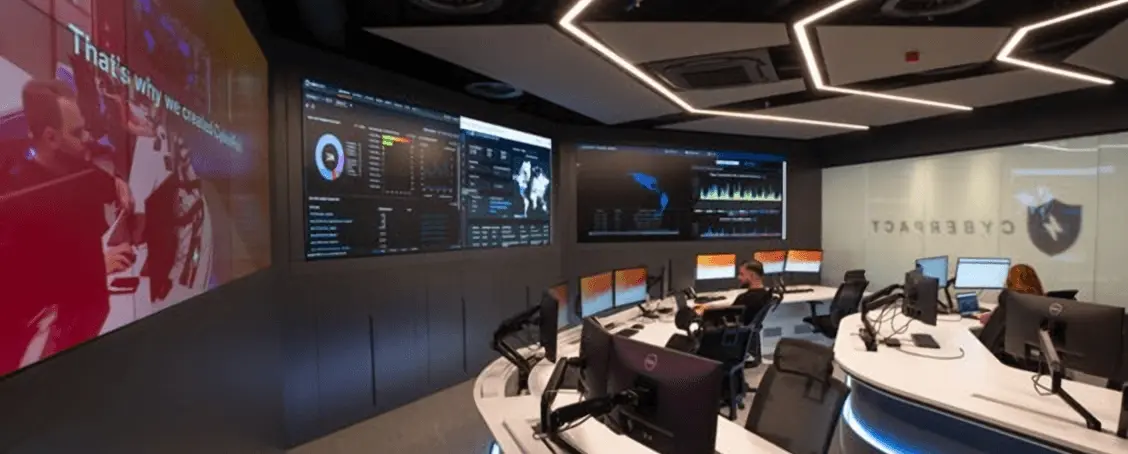
The Senkron ROC is a key component of our digital operating model, consolidating real-time data from all five generation technologies within a single monitoring and coordination platform. This structure enables standardized performance tracking, faster response capability and portfolio-wide situational awareness across geographically dispersed assets. Cloud and edge computing infrastructure supports increasing data processing requirements and scalability, ensuring secure and uninterrupted data flows across assets and decision-making processes.

Advanced data analytics, AI-supported models and performance monitoring systems are embedded into decision-making across the organization. Through predictive analytics, forecasting models and integrated monitoring systems, including predictive maintenance and reliability-centered maintenance frameworks, we enhance asset behavior analysis, production forecasting and predictive maintenance capabilities. These analytical capabilities extend into commercial operations, where digital trading systems, automated tools and market intelligence infrastructure support portfolio positioning and real-time decision-making across electricity, natural gas and environmental markets. These capabilities enable more efficient resource allocation and improved value capture across the portfolio.

Image

Cybersecurity and digital resilience are core components of our digital strategy. Through the CyberPact platform and internationally aligned frameworks, we protect critical infrastructure, operational technology systems and digital assets against evolving cyber risks, supported by a dedicated Security Operations Center (Senkron SOC) operating in real-time coordination with the Senkron ROC shift team. Originally developed to support our own portfolio, the Senkron Digital product family, including the OnePact performance analytics suite, the CyberPact cybersecurity platform and a broader set of managed service offerings, has evolved into scalable digital offerings deployed across more than 15 countries and four continents, managing and securing more than 9 GW of generation capacity for both Enerjisa Üretim and third-party asset owners. Senkron Digital now operates as a software and managed services business, generating revenue through platform licensing and managed service agreements, positioning digital capability not only as an operational enabler but as an adjacent growth vector.

Image

This digital foundation allows us to manage a growing and increasingly complex portfolio with operational discipline, extract value from data at every level of the business and scale our operations without proportional resource growth, reinforcing our competitive position and strengthening our ability to deliver sustainable financial performance in an increasingly data-driven energy system.

Image

WE EMPOWER HUMAN POTENTIAL

Our Human Focus

We build a high-performance organization through continuous learning, safety, collaboration and accountability, developing the capabilities needed for long-term success. We define high performance not only through operational and financial results, but through the organization’s ability to sustain execution over time and deliver impact together with employees, teams, suppliers and business partners while protecting people, empowering participation and supporting continuous improvement.

Empowering the workforce to build a future-ready organization is a core priority. We invest in reskilling and upskilling initiatives to equip employees with the capabilities needed for the energy transition and digitalization, while supporting a just and inclusive transition for employees and communities connected to our operations. Employee development is delivered through leadership, technical, digital and artificial intelligence training programs, field-based experiences, cross-functional projects and digital platforms. We also invest in early talent programs, university partnerships and initiatives that support a more diverse workforce, including efforts to increase the participation of women in engineering and technical roles. Through structured learning ecosystems, employees at all levels access technical, functional and behavioral development opportunities aligned with evolving operational and business needs.

Our Employer Value Proposition, “This Is Our Impact”, reflects our belief that the future of energy will be shaped not only by technology and investment, but also by people. Through our EVP, we aim to create an environment where individuals can take ownership, develop new skills and contribute to meaningful outcomes for business, society and the energy system. These principles shape how we work across the organization through open communication, a field-oriented management approach and a culture of participation, learning and continuous improvement.

Ensuring the highest standards of occupational health and safety remains a non-negotiable priority across our operations and value chain. Through our “OHS Always” approach, every employee and contractor has the right and responsibility to identify risks, report unsafe conditions and stop work when necessary. We position safety as a shared organizational responsibility supported by proactive risk management, employee involvement and operational accountability across all business activities.

Alongside physical safety, we recognize the importance of psychological and social wellbeing in supporting a healthy working environment. Through preventive health practices, psychosocial support mechanisms and targeted wellbeing programs, we promote long-term workforce health across our operations. Inclusion, equal opportunity and psychological safety are embedded into our culture through structured diversity, equality and inclusion initiatives, inclusive communication practices and employee voice mechanisms. Gender-Based Violence and Harassment (GBVH) and Human Rights trainings support awareness around violence, harassment, discrimination and equal opportunity, reinforcing a respectful and inclusive working environment. Further information on our people, health, safety, wellbeing and inclusion practices is provided in Our Human Focus chapter of this report.

Occupational health and safety extends across the value chain, with OHS competence treated as a decisive criterion in supplier selection, onboarding and evaluation, reinforcing safety as a shared responsibility beyond our own operations. Through supplier training and development programs, we support the enhancement of operational, safety and ESG-related capabilities across our value chain. In regions where our power plants operate, we contribute to local economic development by enabling small businesses and local partners to become part of our growth journey.

Through this integrated approach, we build a future-ready organization capable of sustaining performance, supporting operational continuity and enabling long-term value creation. In a sector where attracting and retaining specialized talent is increasingly competitive, our ability to develop capabilities internally, sustain a high-performance culture and foster ownership and participation is a strategic differentiator.

Image

WE DRIVE THE ENERGY TRANSITION RESPONSIBLY

Sustainable Growth and Energy Transition

We support sustainable growth through a transition strategy that balances environmental responsibility, reliable energy supply and long-term value creation.

Our approach is built around four interdependent pillars: renewable energy expansion, technological innovation and operational optimization, repurposing of fossil-based generation, and nature-based solutions and ecosystem stewardship. Together, these pillars translate decarbonization objectives into a resilient pathway while maintaining electricity system stability as a core constraint.

Renewable expansion constitutes the primary growth vector of our strategy. We scale wind, hydro and solar generation through a combination of greenfield investments, capacity additions at existing assets, hybrid applications and storage integration, ensuring both operational efficiency and capital allocation discipline. YEKA projects serve as a cornerstone of disciplined and competitive renewable growth, enabling us to expand wind capacity at scale while aligning investment decisions with long-term system needs and regulatory design. The YEKA-2 WPP and YEKA-2024 WPP projects, in particular, support portfolio decarbonization, strengthen renewable capacity and strengthen long-term earnings visibility within our renewable-led growth pathway. YEKA-2 WPP provides a 15-year USD-linked revenue stream, while YEKA-2024 WPP offers market-based pricing during an initial six-year period supported by a defined price floor of 49.5 USD/MWh, followed by a 20-year USD-linked support mechanism. Together, these structures reduce market exposure and earnings volatility, enhance long-term cash flow predictability and support the balance-sheet resilience required throughout the investment cycle. Upon completion, these new wind investments are expected to displace approximately 3.75 million tons of CO₂ annually.

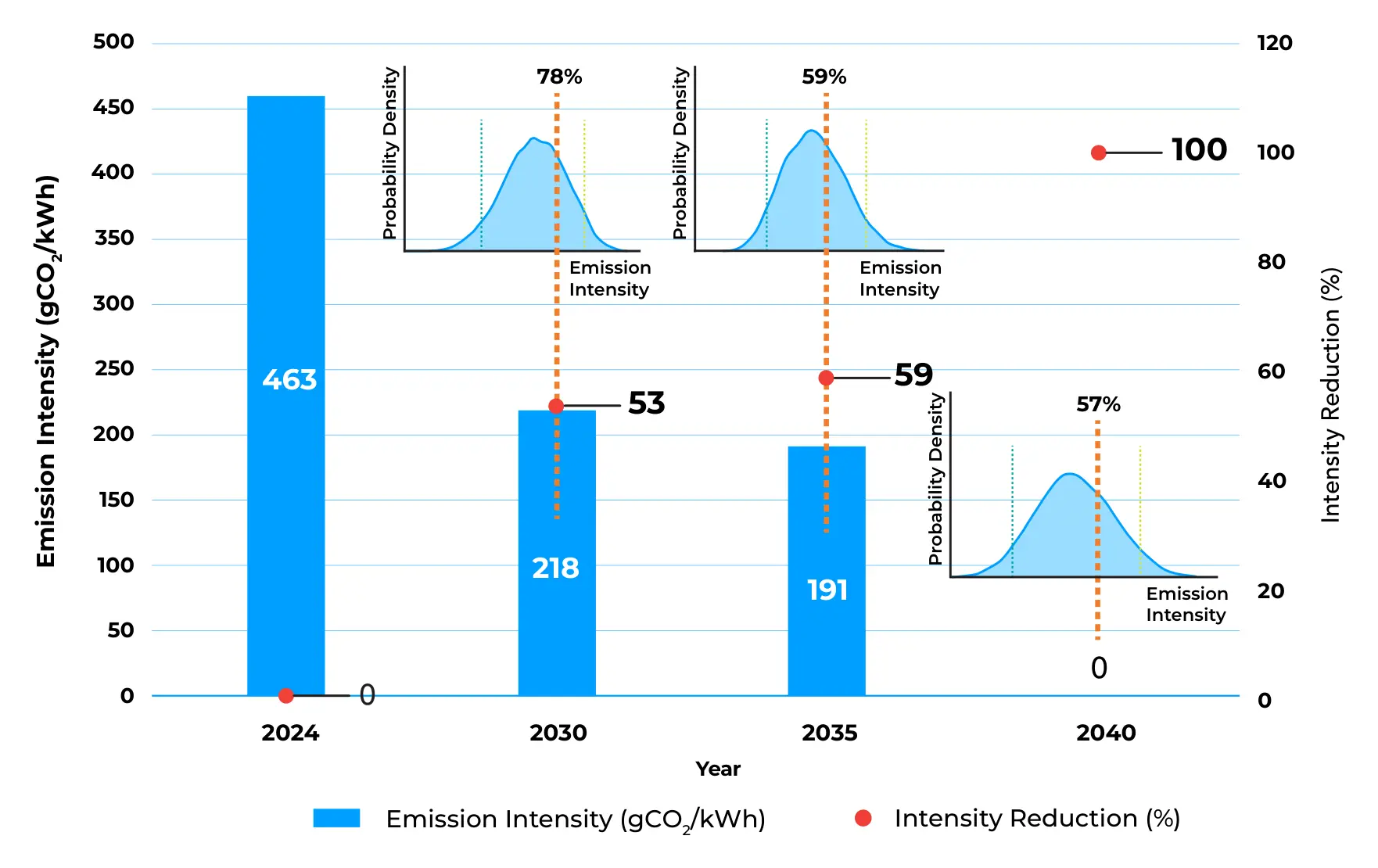
We pursue decarbonization through a phased and system-oriented transition rather than abrupt asset exits. Alongside renewable growth, we focus on the gradual repositioning of thermal assets into lower-emitting and more flexible generation platforms, ensuring that existing assets continue to support grid stability, adequacy and flexibility during the transition to higher renewable penetration. This pathway explicitly manages the tension between decarbonization and system requirements such as affordability and system reliability. Where fossil-based assets are repositioned or retired, our transition plan includes support for affected employees and communities, reflecting our commitment to a just and inclusive transition aligned with regional economic development. Guided by our Climate Transition Plan, our 2040 Net-Zero ambition for Scope 1 and 2 emissions serves as a directional anchor for portfolio, technology and capital allocation decisions, positioned more than a decade ahead of Türkiye’s 2053 national commitment and shaped as a scenario-informed pathway rather than a fixed end point. Our transition pathway focuses on reducing emission intensity, improving operational efficiency, optimizing resource use and expanding renewable generation while maintaining system reliability. Further information on our Climate Transition Plan, emissions trajectory and climate targets is provided in 2025 Performance and Outlook section of this report.

Image

We integrate responsible resource management into project development and operations through water stewardship, waste management and circular economy practices. Ecosystem stewardship is embedded into investment planning and project development, applying internationally recognized approaches to avoid, minimize and manage environmental impacts while supporting long-term ecosystem resilience. In parallel, we advance nature-based solutions and land-use practices that contribute to biodiversity conservation, climate resilience and sustainable development. We also strengthen sustainable supply chain management, with supplier assessment and development practices supporting ESG compliance and responsible business standards across the value chain, helping extend sustainability expectations beyond our own operations. Detailed information on resource management, biodiversity and environmental performance is presented in 2025 Performance and Outlook section of this report.

The transition strategy incorporates social and regional dimensions of transformation, recognizing that long-term value creation is closely linked to community alignment and social stability. We have published Türkiye’s first site-specific Just Transition Roadmap for a privately operated lignite facility, developed for the Tufanbeyli Energy Base through structured engagement with local communities, academic institutions, labor unions and government bodies. The roadmap comprises 20 project proposals across two pathways: employment and skills transformation, and rural and regional economic revitalization.

Regional development initiatives, renewable energy skills certification programs and support mechanisms for women’s participation and broader inclusion in the energy transition workforce are designed to prepare employees, contractors and local communities for future opportunities. Through stakeholder partnerships and collaboration with public institutions, universities and local organizations, we support long-term regional resilience alongside decarbonization objectives.

Sustainable finance is treated as part of the transition architecture rather than as a separate funding label. Our Green Finance Framework, sustainability-linked instruments and relationships with international development finance institutions support access to diversified and competitively priced funding sources aligned with verified low-carbon and transition-enabling activities, linking financing directly with eligible investments, impact reporting, lender expectations and our long-term transition pathway. We align our transition strategy with evolving ESG expectations and regulatory frameworks by actively monitoring and responding to climate-related policy developments, including the EU Taxonomy, CBAM, carbon pricing mechanisms and sustainable finance requirements.

By integrating renewable expansion, decarbonization, responsible resource management and just transition principles within a coherent strategic framework, we strengthen our role as a contributor to Türkiye’s energy transition. With a net-zero target more than a decade ahead of the national commitment, the country’s first private-sector just transition roadmap and one of Türkiye’s largest renewable investment programs, we aim to lead the transition not only in scale but in credibility, responsibility and long-term value creation.

Innovation and emerging technologies support our strategic priorities by enhancing portfolio flexibility, system reliability, and operational efficiency. We prioritize technologies with a clear financial and operational impact, particularly storage and hybrid solutions, advanced analytics and automation, and asset digitalization managed according to maturity stage, from proof-of-concept to scalable deployment, to ensure capital discipline and avoid unproductive technology spending.

As portfolio complexity increases, innovation functions not only as a technology agenda, but as an operational scalability, resilience and efficiency strategy enabling us to manage growing scope without proportional increases in workforce.

DIGITAL OPERATIONS AND AUTOMATION (DEPLOYED AND SCALING)

Image

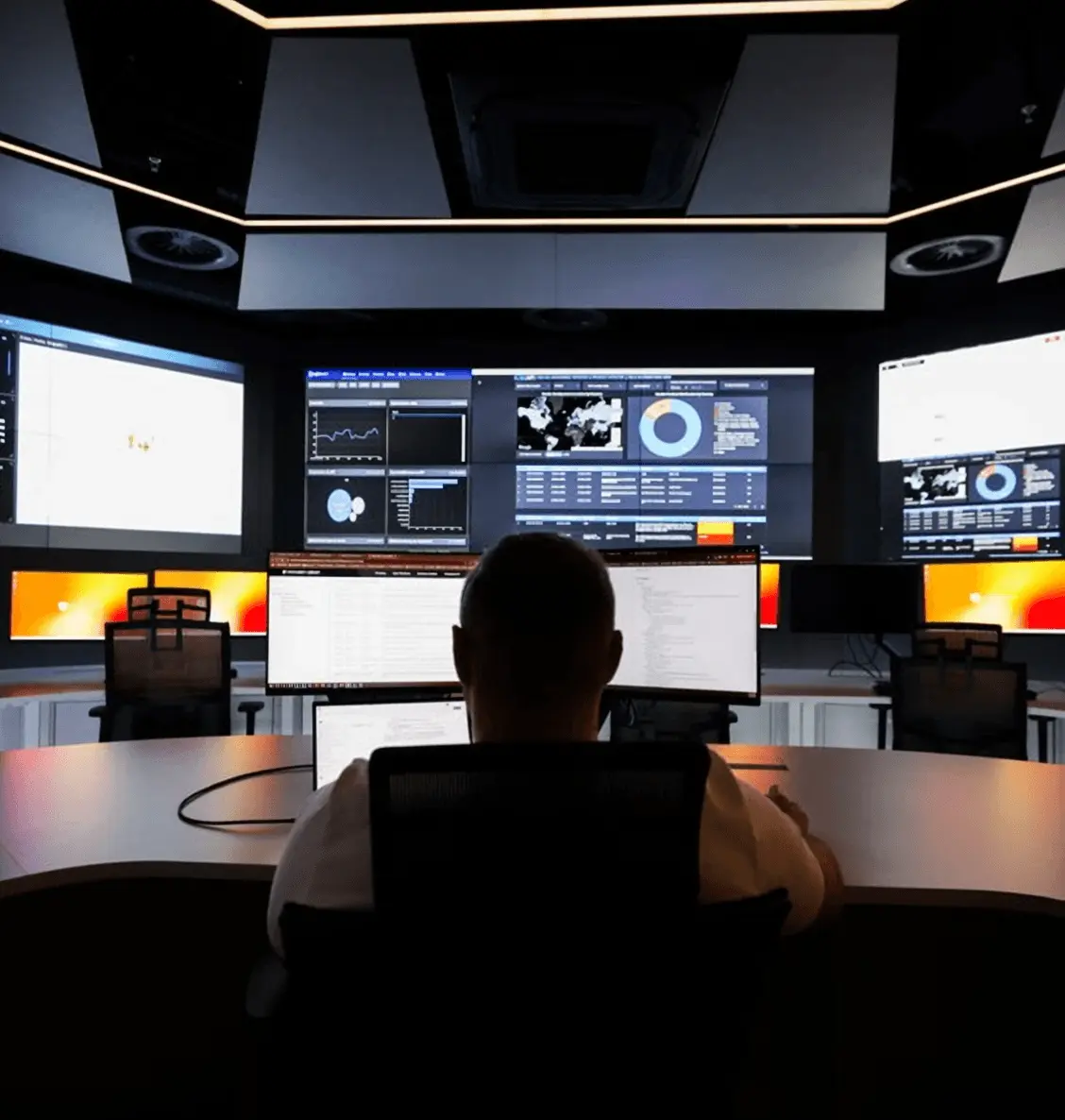
Senkron ROC constitutes the operational core of our digital model.
From a single center, a team of 16 operators monitors and controls 32 power plants owned and operated by Enerjisa Üretim across five generation technologies, alongside 13 external assets managed through the ROC-as-a-Service approach. Senkron Digital’s broader product portfolio, including OnePact® and CyberPact®, manages and secures more than 9 GW of installed capacity across 15 countries and four continents. By continuously processing more than 50,000 signals per second across Enerjisa Üretim’s operations, the ROC delivers real-time visibility, reporting and operational optimization. Despite increasing data volumes, operators maintain full situational awareness, making digital maturity a key enabler of operational consistency, reliability and system resilience. This model allows the portfolio to scale without proportional headcount growth, directly supporting cost efficiency, complemented by a Mobile Operations Center (MOC) ensuring uninterrupted capability during infrastructure disruptions, strengthening resilience and reducing potential revenue losses from downtime. AI-supported solutions automate routine reporting and data consolidation, reducing manual processing time by approximately 10% and freeing capacity for higher-value activities. Predictive maintenance, digital twin lifecycle tracking and unified SCADA systems support the transition toward autonomous plant operations, extending asset life, reducing unplanned outages and optimizing maintenance cycles, ultimately lowering capital expenditure across the portfolio and improving return on invested capital.

A major milestone is the Artificial Plant Manager initiative at hydroelectric power plants. By combining advanced monitoring with rule-based algorithms, hydro assets operate in self-controlled modes capable of managing routine decisions within predefined limits and with reduced manual intervention. This approach enables ROC teams to focus on exception management and higher-value decision-making.

The NEW AGE program further accelerates this transformation through agile principles, cross-functional teams and product-based delivery models, redesigning operational and digital workflows to shorten feedback loops and accelerate deployment of digital solutions.

STORAGE, HYBRID AND SYSTEM FLEXIBILITY (PILOT TO DEPLOYMENT)

Image

Energy storage and hybrid systems directly support system adequacy and flexibility under increasing renewable penetration. We have secured pre-licenses for 500 MW of wind capacity paired with 500 MWh of battery energy storage across three projects (19 Mayıs, İzmit and Malkara WPPs).

Hybrid solar capacity totaling 90 MW has been commissioned across existing wind and thermal assets, with a target of 157 MW by 2028, supporting higher capacity utilization, improved asset profitability and long-term decarbonization objectives. These early deployments generate valuable operational data, supporting more informed and disciplined scaling decisions while reducing execution risk for future investments.

The Bandırma Energy Base serves as our integrated technology platform,
bringing together five generation technologies on a single site: natural gas combined-cycle capacity, an integrated hydroelectric plant supporting internal energy needs, hybrid and on-grid solar installations including an agrivoltaic application, a 6 MW Enercon E-175 EP5 prototype wind turbine, featuring one of the world’s largest onshore rotors at 175 meters and installed as the first prototype of Enercon’s next-generation onshore platform in Türkiye, and Türkiye’s first ministry-approved grid-integrated Battery Energy Storage System, a 2 MW / 4 MWh pilot that has begun commercial balancing operations, complemented by a small-scale green hydrogen unit currently used in generator cooling. This co-located structure allows us to test the physical, digital and commercial interactions between conventional generation, renewables, storage and hydrogen in real operating conditions. Green hydrogen remains at the operational learning stage; we view it as a long-term optionality pathway rather than a near-term deployment priority, ensuring that investment focus remains on technologies with clearer return visibility.

ADVANCED ANALYTICS AND DECISION SUPPORT (DEPLOYED)

Image

Scenario analysis, flexibility modelling, storage-system interaction modelling, and optimization tools support the evaluation of storage systems, hybrid configurations, hydrogen pathways and emerging technologies under uncertain market and system conditions. These analytical capabilities support the commercial evaluation of flexible assets, renewable integration analytics and optimal dispatch decisions beyond technical feasibility alone, strengthening both strategic readiness and investment discipline.

Reservoir management is optimized through weather data, satellite imaging and flow forecasting models that enable more accurate inflow projections and informed water resource allocation across the hydroelectric portfolio. Generative AI, machine learning and advanced analytical applications are integrated into knowledge discovery and decision-support processes, supporting more effective use of both structured and unstructured operational data, technical documentation and market information while improving scenario exploration, analysis speed and decision-making across the organization.

These capabilities are complemented by Senkron Digital’s OnePact® and CyberPact® platforms, supporting performance monitoring and cybersecurity across internal and third-party assets. We scout startups specialized in energy management systems and decision-support platforms to further strengthen scalable, data-driven decisions.

LONG-TERM EXPLORATION AND PARTNERSHIPS (SCOUTING AND PROOF-OF-CONCEPT)

Image

In parallel, we actively test early-stage energy solutions through pilot applications and proof-of-concept studies. Current focus areas include perovskite solar technologies, an early-stage carbon capture proof-of-concept at the Tufanbeyli lignite power plant, and advanced turbine technologies including a horizontal surface Archimedean turbine at the Hacınınoğlu Power Plant capable of operating at very low flow rates. We are also evaluating next-generation robotics technologies and autonomous drone solutions focused on anomaly detection, mapping and asset inspection capabilities. Preparations have been completed for participation in EU Horizon projects covering advanced perovskite photovoltaics recycling, photovoltaic-battery optimization, wind system reliability and AI-driven smart energy systems. Our New Technologies Department acts as a bridge between Enerjisa Üretim’s strategic priorities and the global innovation ecosystem, identifying, evaluating and testing emerging solutions from startups, academic institutions and technology providers across emerging generation technologies, autonomous operations and predictive maintenance supported by structured horizon-scanning practices spanning next-generation renewables, water technologies, cybersecurity and advanced robotics.

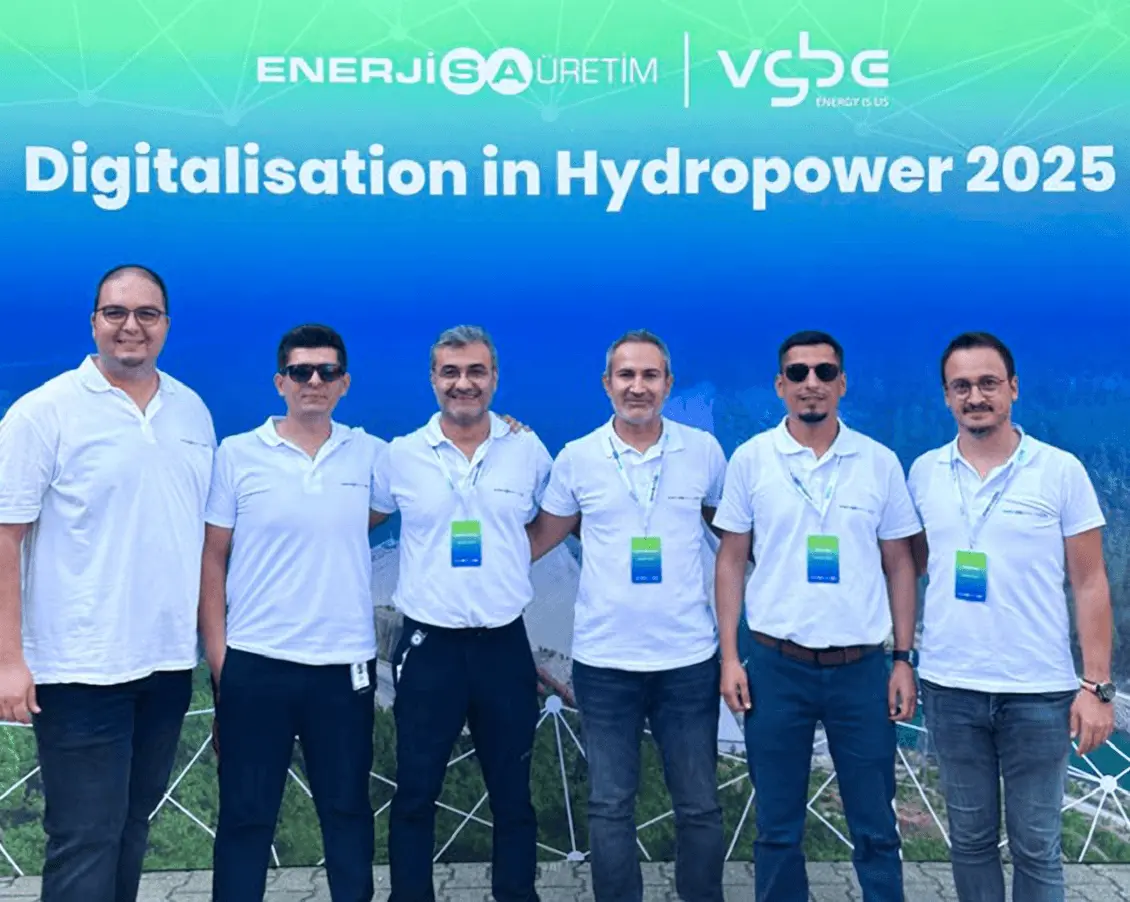
International collaborations and sector platforms extend this innovation agenda beyond our own portfolio. In 2025, Enerjisa Üretim was selected by leading international consultancies as a reference site for integrated digital operations, hosting peer companies from more than 20 countries at Senkron ROC and the Bandırma Energy Base. During the year, we also co-hosted the international “Digitalization in Hydropower 2025” event with VGBE in Türkiye and conducted Türkiye’s first live OT cybersecurity drill, contributing to institutional capability building, cross-sector knowledge sharing and the advancement of digital operational standards across the energy sector.

Our innovation ecosystem is further strengthened through structured access to global venture deal-flow across Türkiye, the United States and Europe. This external deal-flow, combined with the consolidated R&D and integration platform concentrated at the Bandırma Energy Base and disciplined governance through our internal Innovation Committee, allows us to identify, test and integrate emerging solutions in a strategy-aligned and capital-disciplined manner.

Looking ahead, our innovation agenda will continue to prioritize technologies that deliver measurable operational, system and financial value. Near-term priorities include scaling BESS deployment through the 500 MW pre-licensed pipeline, deepening AI-driven automation across ROC operations and advancing digital twin integration across the asset base. Together, these initiatives are expected to support operational efficiency, strengthen asset performance and enhance earnings quality. Over the longer term, we will continue to evaluate green hydrogen pathways, carbon capture applications and next-generation renewable technologies as they approach commercial readiness, ensuring disciplined capital allocation to proven and scalable solutions, while selectively preserving exposure to emerging growth opportunities aligned with our portfolio transformation objectives.

We translate our strategic priorities into execution through a structured, phased and time-bound roadmap that integrates financial discipline, operational excellence and sustainability objectives within a single decision-making framework.

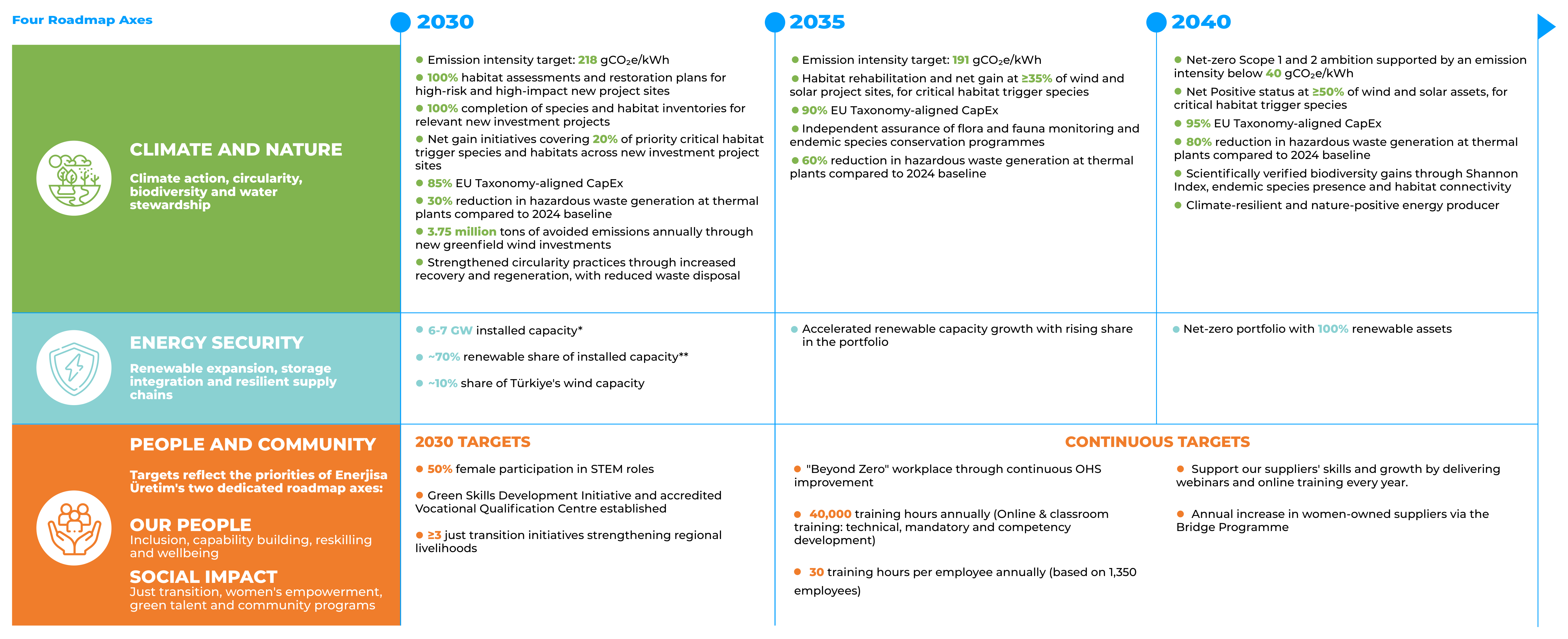
The roadmap extends toward 2028, 2030, 2035 and 2040 and advances along four core axes: environmental stewardship, energy security, our people and social impact. Each axis reflects an area where our capital allocation, operational capabilities and stakeholder commitments interact with evolving policy frameworks, technology readiness and market conditions to shape the long-term quality, resilience and sustainability of our portfolio and the value we create for all stakeholders. This structure enables us to manage trade-offs between growth, system contribution and long-term value creation. At the same time, it preserves strategic flexibility allowing the portfolio to adapt to changing external conditions while maintaining execution discipline and consistency.

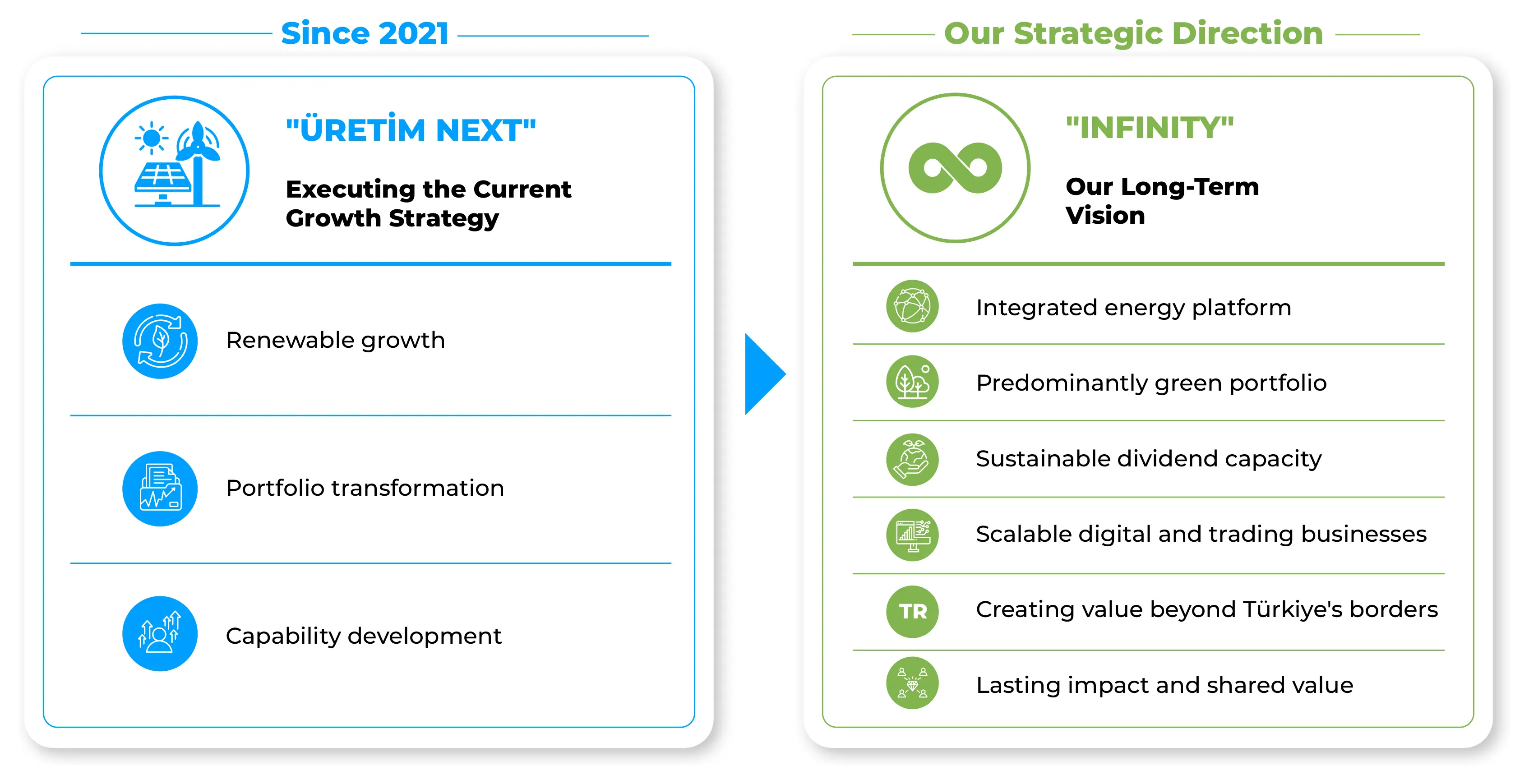
FROM “ÜRETİM NEXT” TO “INFINITY”

Our current roadmap builds on the “Üretim Next” phase launched in 2021, which marked the beginning of a new investment cycle centered on renewable growth, portfolio transformation and capability development.

While “Üretim Next” represents the execution phase of our current growth trajectory, it also prepares the foundations for our longer-term “Infinity” vision. Through the “Infinity” phase, we aim to further strengthen our position as an integrated energy platform with a predominantly renewable portfolio, strong earnings visibility, sustainable dividend capacity, and scalable digital and trading businesses that create value beyond Türkiye’s borders. This evolution expands Enerjisa Üretim’s value creation engine beyond generation, introducing new revenue capacities and enhancing structural growth potential over time. In parallel, we seek to uplift both the company and the broader ecosystem, generating lasting impact and shared value.

Image

DELIVERING “ÜRETIM NEXT”

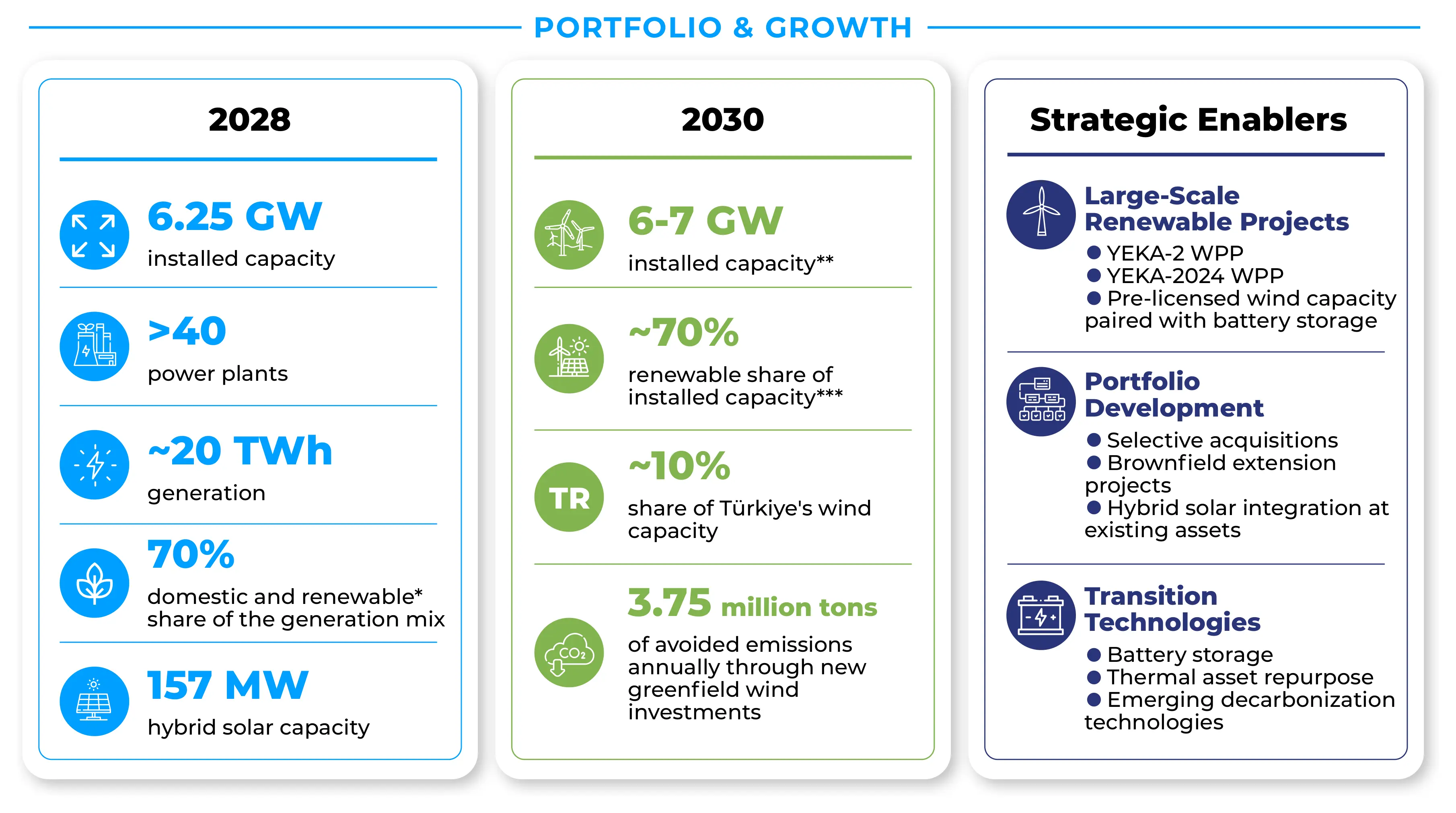
By 2028, we prioritize the delivery of secured renewable capacity pipelines, stabilization of cash flows from newly commissioned assets and reinforcement of balance sheet resilience following peak investment years. Within this framework, we target to reach 6,250 MW of installed capacity across more than 40 power plants by 2028, with domestic and renewable resources representing approximately 70% of the generation mix. By 2030, we aim to further scale and strengthen our generation portfolio, targeting 6 to 7 GW of installed capacity with a renewable share nearly 70%. This growth is supported by a diversified generation mix, preserving exposure to baseload, flexible and renewable assets to ensure system reliability and optimize market positioning. This dynamic portfolio approach enables us to continuously rebalance in response to evolving market conditions and regulatory priorities, while contributing to system flexibility and reliability.

Beyond 2030, the roadmap shifts toward portfolio optimization, disciplined reinvestment, flexibility enhancement and the managed transition of conventional assets, aligning technical lifetimes with market conditions and climate objectives.

The growth pipeline to 2028 is anchored by the YEKA-2 WPP and YEKA-2024 WPP projects, expected to add approximately 1,750 MW of new wind capacity, strategic M&A and extension projects in our existing wind sites, complemented by approximately 500 MW of pre-licensed greenfield wind capacity paired with battery storage of equivalent scale. The pipeline is further supported by selective acquisitions and brownfield expansions aimed at improving portfolio quality, increasing renewable share and enhancing overall return profile. Execution is supported by clear financial guardrails: a disciplined capital allocation, investment return thresholds aligned with our cost of capital, and a dividend approach calibrated against free cash flow generation and leverage discipline.

Portfolio discipline also extends to active portfolio management, including selective divestment of non-core or sub-scale assets where proceeds are redeployed into higher-value growth opportunities, strengthening portfolio quality while enhancing balance sheet flexibility and capital efficiency.

“Üretim Next” Milestones

Image

Scaling renewable capacity, strengthening portfolio resilience and creating value through disciplined execution

* Domestic and renewable resources reflect the renewable portion together with domestic conventional generation.
** Including hybrid capacity.
*** Including hybrid capacity.

Image

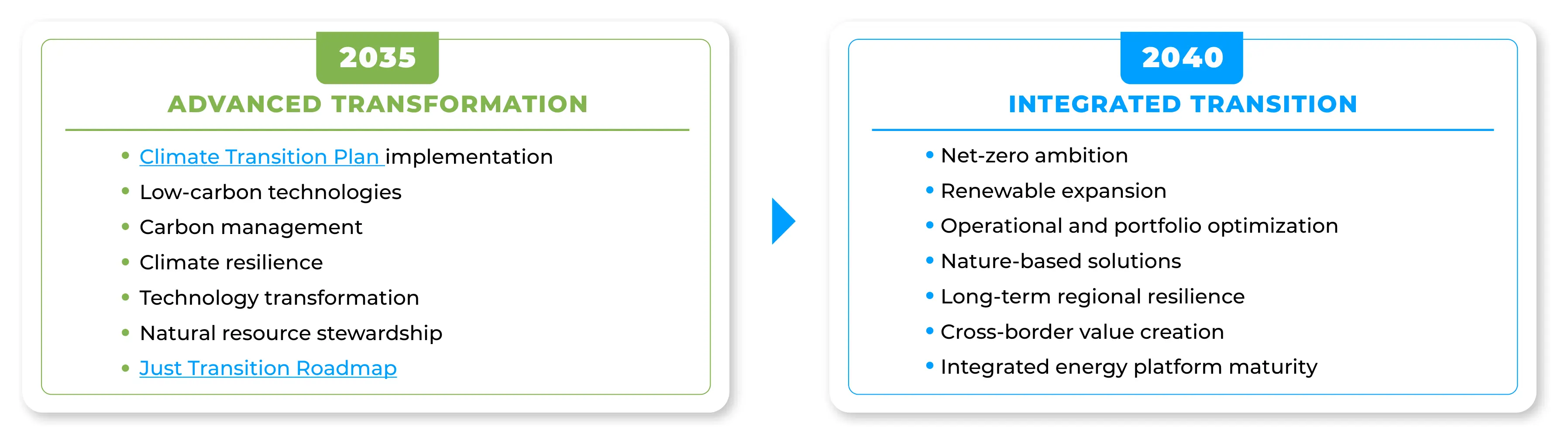
Preparing the portfolio, capabilities and transition pathways required for long-term resilience and sustainable value creation

TOWARD “INFINITY”

The 2035 horizon represents a more advanced phase of portfolio transformation, where low-carbon technologies, emission intensity reduction, operational efficiency and climate resilience become increasingly integrated into operational execution and investment decisions. Carbon management, technology transformation and natural resource stewardship are evaluated together within the framework established by our Climate Transition Plan.

By 2040, renewable expansion, operational optimization, portfolio transformation, low-carbon technologies, carbon management and nature-based solutions converge within an integrated transition pathway supporting our net-zero ambition for Scope 1 and 2 emissions. The pace and sequencing of this convergence will be driven by the maturation of enabling technologies, the evolution of carbon pricing frameworks and broader energy system conditions, ensuring that decarbonization is delivered in a disciplined and economically sustainable manner.

Türkiye’s evolving carbon pricing framework, including the pilot ETS and the EU CBAM transitional period are actively integrated into our financial modelling and investment screening processes, strengthening our ability to assess long-term portfolio implications and optimize capital allocation decisions.

RESPONSIBLE GROWTH

Our long-term growth ambitions are supported by an integrated approach that considers climate, nature, resource efficiency and social value creation together. Our Climate Transition Plan provides the strategic direction, while operational practices across the portfolio translate these commitments into measurable, site-level execution, ensuring consistency between strategy and implementation.

We integrate circularity, water stewardship, waste management, biodiversity and ecosystem resilience as complementary dimensions of long-term value creation, including our continued commitment to supporting safely managed water, sanitation and hygiene (WASH) for our workforce and the communities where we operate. Environmental performance considerations, including water stress, habitat sensitivity, rehabilitation, resource consumption and local ecosystem impacts, are evaluated from the earliest stages of project development and integrated into operational KPIs and investment processes, strengthening both execution quality and long-term asset resilience.

Our biodiversity roadmap extends from project pre-feasibility to the operational period embedding biodiversity as a decision gate within investment and operational processes. At portfolio level, we apply integrated monitoring, no net loss and net gain approaches and Biodiversity Action Plans (BAP), species translocation, receptor habitat management and long-term monitoring practices integrated into operational decision-making and adaptive management mechanisms across the renewable portfolio. By 2028, we aim to establish comparable baseline, monitoring and mitigation datasets across all operational renewable sites. By 2030, biodiversity screening, critical habitat management and no net loss principles are expected to function as standard investment decision gates, with net gain initiatives progressively extended across priority species and habitats. By 2035, portfolio-level monitoring outcomes are expected to support net gain assessments, complemented by habitat rehabilitation across our wind and solar assets. By 2040, we aim for net gain to be delivered across a broader share of priority species and habitats, with impacts on nature measured, managed and monitored with data quality suitable for independent assurance.

The transition of the energy system also requires balancing decarbonization objectives with affordability, system reliability and regional development priorities. Our Just Transition Roadmap supports the orderly evolution of the portfolio while addressing socio-economic impacts, workforce implications and long-term regional resilience.

Tufanbeyli Energy Base remains central to this approach, where operational efficiency, emissions intensity reduction, technology transformation and regional value creation are advanced together within a long-term transition perspective. Rehabilitation and community resilience are assessed alongside environmental and operational priorities. Community benefit-sharing mechanisms are designed to distribute the benefits of transformation across the wider ecosystem.

The cumulative effects of these growth, transition and stewardship priorities advance along the four roadmap axes, translating our strategic priorities into measurable outcomes across the 2028, 2030, 2035 and 2040 horizons. Climate and Nature captures climate action, circularity, biodiversity and water management. Energy Security reflects renewable capacity build-out, system flexibility through storage and the climate resilience of our assets. Our People axis brings together inclusion, capability building, reskilling and wellbeing across an evolving workforce. Social Impact covers Just Transition delivery, regional development, women’s empowerment in the energy sector and community programs.

Together, these axes anchor accountability, enable transparent tracking and connect our roadmap with long-term value creation for shareholders, employees, communities and the broader energy system.

Roadmap to 2040

Translating our six strategic priorities into measurable progress and shared value across four roadmap axes

* Including hybrid capacity.
** Including hybrid capacity.

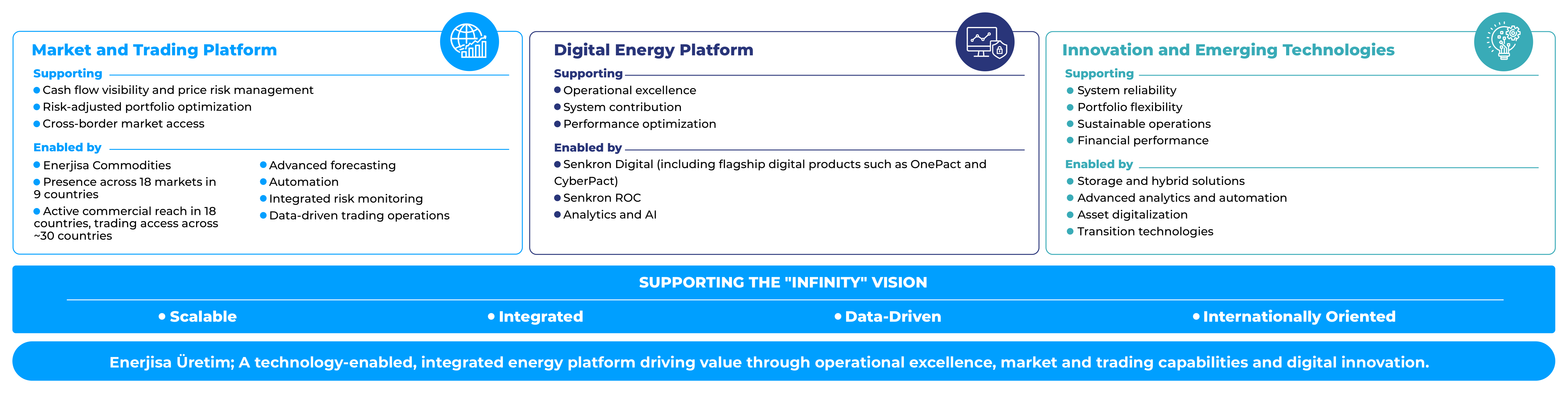
INTEGRATED VALUE CREATION SUPPORTING THE “INFINITY” VISION

Our integrated value creation model combines three platforms (generation, market and trading, and digital) that operate together to translate our six capitals explained further in Our Value Creation Model chapter into long-term value. The generation platform, anchored by our diversified five-technology portfolio and the renewable expansion described above, forms the operational foundation of the business. This foundation is reinforced by the market and trading and digital platforms, supported by cross-cutting innovation and emerging technologies, which together enhance portfolio performance, market optimization and operational excellence, creating a self-reinforcing value generation cycle across the investment cycle.

Market and Trading Platform
Enerjisa Commodities supports operational resilience, cash flow visibility and risk-adjusted portfolio optimization across volatile and interconnected energy markets. Following a significant expansion in 2025 with entries into Italy, Hungary, Serbia, Bulgaria, Switzerland and Austria,

Enerjisa Commodities now operates across 18 organized and bilateral power and gas markets in eight European countries alongside Türkiye, with active commercial presence extending across 18 countries and trading access reaching approximately 30 countries in power, gas and environmental products. Operating through an asset-light structure, its roadmap prioritizes advanced forecasting, automation, integrated risk monitoring and disciplined governance, building capabilities demonstrated through 2025 milestones such as first physical storage optimization and first cross-border physical gas transportation. Hedging activities anchor price risk management and strengthen cash flow predictability across the generation portfolio.

Digital Energy Platform
Our digital roadmap builds on the capabilities developed through Senkron Digital and the centralized operating model established through the Senkron ROC. Advanced analytics, artificial intelligence applications and integrated digital solutions enhance operational excellence, system contribution and performance optimization across our generation portfolio, while strengthening scalable digital businesses serving both our own operations and a broader ecosystem, creating additional value beyond internal operations.

Innovation and Emerging Technologies
Innovation and emerging technologies are embedded across our portfolio, operations and decision-making frameworks as system-enabling capabilities supporting reliability, flexibility, sustainability and profitability. We prioritize technologies with clear operational and financial impact, managing them according to maturity stage from proof-of-concept to scalable deployment. Storage and hybrid solutions, advanced analytics, automation and transition technologies are scaled as system and market conditions warrant, ensuring capital discipline alongside innovation.

Integrated Value Creation
Complementary platforms reinforcing our generation portfolio

FINANCIAL DISCIPLINE AND SHAREHOLDER VALUE

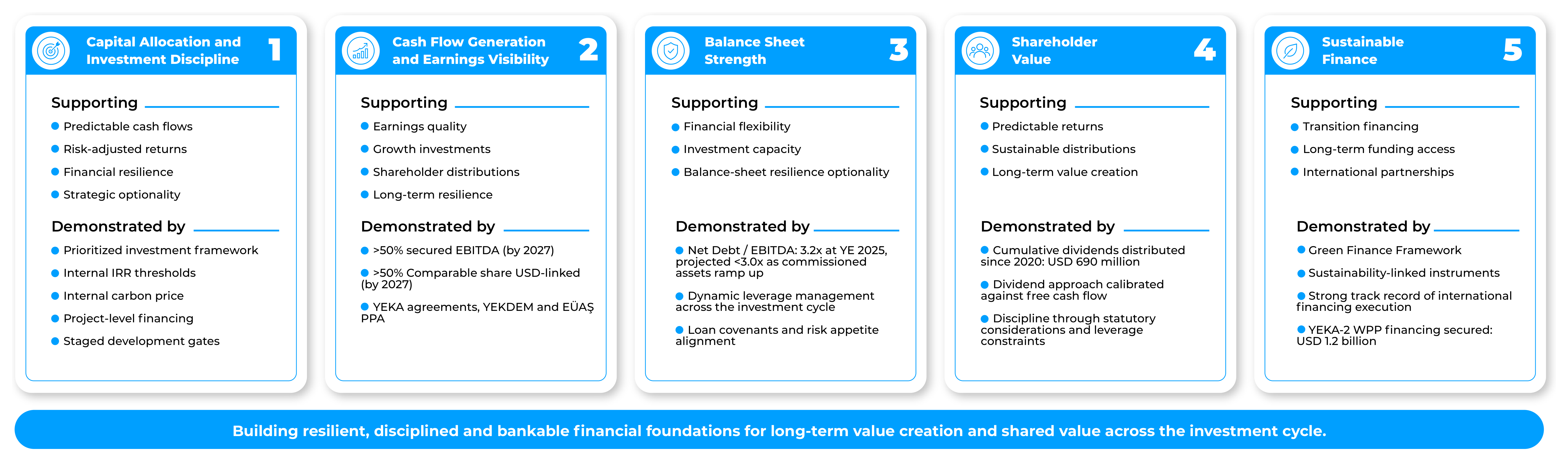
Financial discipline and long-term shareholder value remain central to the execution of our roadmap. We allocate capital with a long-term perspective, balancing growth opportunities with financial resilience and ensuring that investments strengthen portfolio quality, earnings visibility and sustainable value creation.

Capital Allocation and Investment Discipline
Capital allocation is governed by a disciplined and prioritized investment framework focused on projects with predictable cash flows, strong risk-adjusted returns and clear strategic relevance. Renewable growth investments, particularly wind projects supported by YEKA mechanisms, YEKDEM or long-term contracted structures, form the backbone of growth CapEx in the medium term. These investments are complemented by storage and hybrid configurations assessed through staged development gates.

Investment decisions are evaluated against internal IRR thresholds, an internal carbon price, and project-specific risk parameters, ensuring that growth is delivered without diluting returns or balance sheet strength.

Image

Cash Flow Generation and Earnings Visibility
Strong and predictable cash generation underpins the execution of our long-term strategy. Existing assets provide a solid earnings base while portfolio diversification supports resilient performance across different market conditions. Operating cash flow conversion remains a core marker of earnings quality and financial discipline, supporting both growth investments and shareholder returns.

Supported by YEKA agreements, YEKDEM feed-in structures and the EÜAŞ PPA, by the end of 2027, more than 50% of EBITDA is expected to be secured, with a comparable share USD-linked, providing a durable floor of earnings visibility and cash-flow resilience.

Balance Sheet Strength
Financial execution is anchored by a disciplined leverage framework. While leverage is expected to peak during the current investment cycle, Net Debt / EBITDA stood at 3.2x at year-end 2025 and is projected to decline below 3.0x as newly commissioned assets ramp up. Leverage is managed dynamically across the investment cycle, allowing temporary increases during construction phases followed by a gradual reduction as assets become operational and cash generative. Maintaining leverage discipline remains a central consideration in sequencing capital expenditures and shareholder distribution decisions.

Shareholder Value
Our dividend distribution approach reflects a commitment to sustainable and predictable shareholder returns, balanced with our investment cycle and long-term value creation objectives. Distributions are calibrated against free cash flow generation, statutory considerations and leverage constraints, ensuring continuity of returns while safeguarding balance-sheet strength throughout the growth roadmap.

Since 2020, we have distributed a total of USD 690 million in dividends on an accrual basis, reflecting our commitment to shareholder value alongside disciplined growth.

Image

Sustainable Finance
Sustainable finance is treated as part of the transition architecture rather than as a separate funding label. Our Green Finance Framework, sustainability-linked instruments and relationships with international development finance institutions support access to diversified and competitively priced funding sources aligned with verified low-carbon and transition-enabling activities. This approach links financing directly with eligible investments, impact reporting, lender expectations and our long-term transition pathway across renewable, storage and flexibility-enhancing investments.

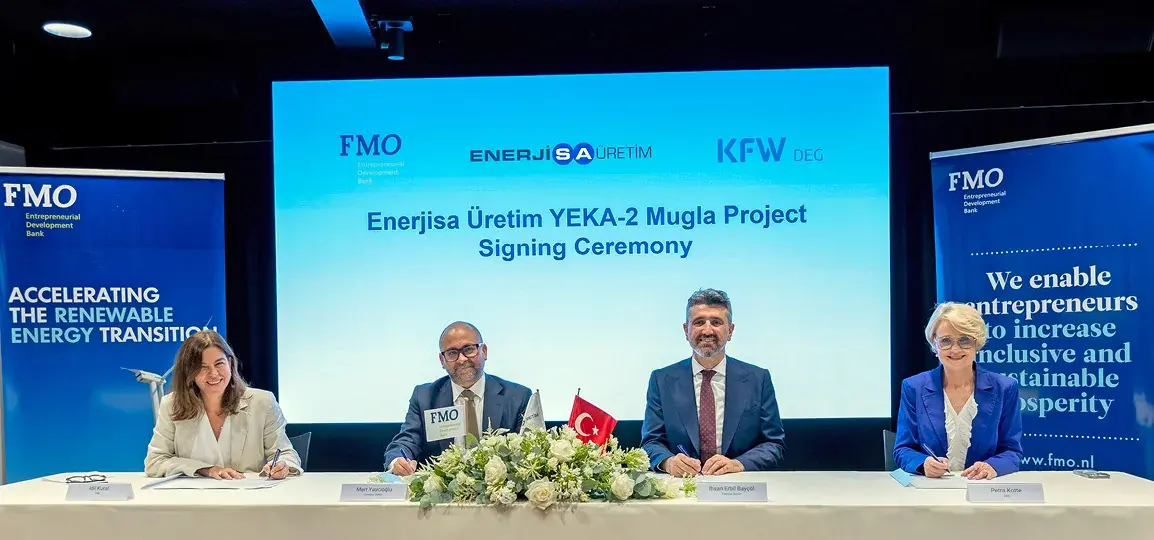
The total financing secured for the YEKA-2 wind power projects amounts to USD 1.2 billion, representing the largest cumulative financing transaction completed in Türkiye’s wind energy sector. In 2025, we became the first company in Türkiye to secure financing from the EBRD dedicated specifically to a YEKA wind project, with up to USD 200 million of this financing supporting approximately 250 MW of additional capacity in Muğla. These transactions reinforce confidence in our long-term growth and transition pathway while demonstrating continued access to international capital markets. We continue to progress toward securing additional financing for the YEKA-2 WPP portfolio, with total commitments expected to reach approximately USD 1.4 billion in 2026.

Financial Discipline And Shareholder Value

GOVERNANCE AND EXECUTION DISCIPLINE

Execution of our strategic roadmap is supported by robust governance structures, including Board-level oversight, dedicated investment committees and periodic strategy reviews. Progress against financial, operational and sustainability targets is tracked through defined KPIs, mapped to our four roadmap axes, enabling adjustments to capital allocation, portfolio priorities and transition levers as external conditions evolve.

Strategy execution is overseen through a quarterly senior management cadence involving the CEO, Executive Vice Presidents and function leaders that reviews progress against strategic KPIs and aligns action plans with our risk appetite. Each milestone across the 2028, 2030, 2035 and 2040 horizons is linked to quantitative targets, accountable owners and review cadences, ensuring that strategic ambition translates into measurable and tracked delivery.

Through this integrated and time-bound roadmap, we are building far more than a power generation company. We are creating an integrated and scalable energy platform that combines growth, financial discipline, operational excellence, responsible transition and sustainability priorities within a coherent framework that enhances system contribution, strengthens resilience and supports long-term value creation for shareholders, employees, communities and the broader energy system. By balancing investment, transition and execution priorities, we continue to advance toward the “Infinity” vision, a scalable, forward-looking energy platform that creates value beyond our generation portfolio and beyond Türkiye’s borders.

Image

INTEGRATED ANNUAL REPORT 2025